

Why Am I Tired but Can’t Sleep? Understanding the Wired but Exhausted Cycle
Updated: Mar 18
You feel exhausted all day. Getting through work takes effort, your energy feels low, and by evening you can barely wait to get into bed. Sleep should come easily after a day like that.
But instead of drifting off, your brain wakes up. Thoughts start moving faster. Your body
feels alert even though you are clearly tired. The more you want sleep, the farther away it seems.
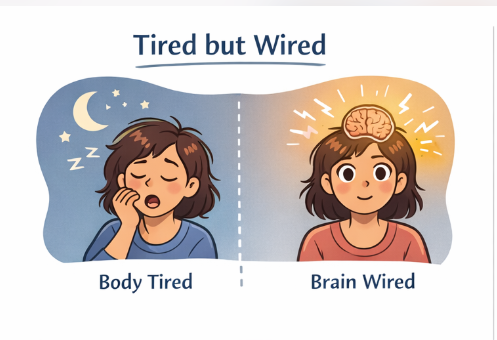
If this sounds familiar, you may be stuck in what many people describe as feeling tired but wired. It is a frustrating experience, and it happens more often than people realize. Many people assume they are doing something wrong or that their body has forgotten how to sleep, when in reality this pattern usually has a very understandable explanation.
To understand why this happens, it helps to look at how sleep and alertness are controlled in the body. Feeling sleepy is only part of the equation. Your nervous system also needs to feel safe enough to power down.
Why You Can Feel Tired and Still Unable to Sleep
Feeling tired but unable to sleep can seem contradictory, but sleep is not controlled by fatigue alone. Research shows that sleep depends on the interaction between sleep pressure and the brain’s alerting system. Sleep pressure builds naturally throughout the day as a substance called adenosine accumulates in the brain, signaling that it is time to rest. Under normal circumstances, this growing pressure helps us fall asleep once we lie down at night. However, sleep pressure can be overridden when the nervous system remains activated.

Studies in sleep medicine describe this state as physiological hyperarousal, a condition commonly seen in people with insomnia. Even when individuals report significant fatigue, measurements of brain activity, heart rate, and stress hormone levels often show increased activation compared to good sleepers. The brain remains partially alert, as though it still needs to monitor the environment, making it difficult to transition into deeper stages of sleep.
Stress hormones play an important role in this process. Cortisol, which normally peaks in the morning and gradually declines throughout the day, can remain elevated into the
evening when mental or emotional stress accumulates. Research has shown that elevated nighttime cortisol is associated with delayed sleep onset and more frequent nighttime awakenings. This does not necessarily mean someone feels anxious. Everyday cognitive load, decision fatigue, and prolonged stimulation from work, screens, or multitasking can signal the brain to remain alert long after the day has ended.
Neuroscience research also suggests that people experiencing sleep difficulties often show increased activity in brain regions responsible for attention and emotional processing at night. Instead of fully powering down, the brain continues to evaluate thoughts, memories, and future planning. This helps explain why many people feel exhausted during the day yet experience racing thoughts or sudden alertness once they try to sleep. The body is ready for rest, but the nervous system has not fully shifted into a restorative state.
In this way, the tired but wired feeling is not a failure of sleep. It is the result of competing biological signals, where the drive for sleep exists alongside a brain that still perceives a need for wakefulness.
The Tired but Wired Brain in the Second Half of the Night
Just because you finally fall asleep doesn’t mean your nervous system is done processing the day. The same alerting signals that made it hard to drift off can persist once you are asleep, quietly influencing your brain and body. Sleep is made up of repeating cycles, and in the second half of the night, the brain spends more time in lighter, active stages, especially REM sleep. During these periods, your nervous system is naturally more sensitive, which makes any leftover activation from stress, mental stimulation, or emotional processing more noticeable. Many people experience this most vividly around 3AM, when the body is still tired but the brain temporarily switches into a state of alertness.
Mid-sleep awakenings are common. Research in sleep physiology shows that most adults

briefly wake multiple times during the night, often without remembering it. What makes some awakenings frustrating is the level of awareness and alertness that can accompany them. Studies on hyperarousal suggest that even subtle stress or cognitive activity can trigger the brain to partially “wake up,” sending signals to the body that make falling back asleep difficult. Heart rate may rise slightly, brain activity resembles wakefulness more than sleep, and thoughts can become more active even though the body remains tired.
REM sleep also plays a key role in this phenomenon. During REM, the brain consolidates memory and processes emotions, and neural circuits involved in attention and emotional regulation remain active. This means the brain is naturally alert even while the body is resting. When combined with leftover stress, mental load, or environmental stimuli, this can make awakenings in the middle of the night feel particularly vivid and frustrating. These awakenings are a normal part of how sleep functions, not a sign that something is broken.
Working With Your Sleep from Evening to Morning
Sleep is a process that unfolds over several hours, and the brain and body move through cycles that naturally influence alertness and rest. From the moment you prepare for bed through the night, fluctuations in nervous system activation can make sleep feel uneven. Viewing these shifts as normal allows you to approach the night with intention rather than frustration.
Instead of trying to control every aspect of sleep, it can help to focus on working with your body’s natural rhythm. There are periods of deeper rest and periods when the brain naturally becomes more active. Recognizing that these cycles are expected provides a foundation for guiding the body back into sleep when brief awakenings or alert moments occur.

Two practical strategies can support this process. The first is to use your breath as an anchor. Slow, steady breathing paired with gentle counting or noticing the rise and fall of your chest gives the brain a predictable signal to shift away from alertness. The second is to engage the body gently without stimulating the mind. Small movements, such as shifting your position, stretching lightly, or tensing and relaxing muscles while keeping your eyes closed, signal to the nervous system that it is safe to rest without increasing mental alertness.
Applied with patience and consistency, these approaches do not force sleep but create conditions where the brain and body can work together naturally. Over time, they help the body return to rest more efficiently after brief moments of alertness and support more continuous, restorative sleep. Even small, deliberate actions can make the night feel smoother and leave you waking up feeling more refreshed.
Taking Control of Your Night
Feeling tired but unable to sleep can be frustrating, but it is a natural result of the brain and body moving through their rhythms. Being aware of these patterns allows you to approach bedtime and the night ahead with intention rather than pressure. Simple strategies, such as using slow, steady breathing or gently shifting your body while keeping your mind calm, can guide the nervous system toward rest. Over time, consistently supporting your natural cycles and giving your body space to settle can help you fall asleep more smoothly and maintain restorative rest. Sleep is not something to force, but a process to work with, and even small, deliberate actions can make a meaningful difference in how rested and energized you feel the next day.
Explore More Support for Your Sleep
If you want to go deeper in understanding your sleep patterns and learning practical ways to manage the tired but wired feeling, there are resources available to guide you. You can explore detailed PDFs that break down strategies for returning to sleep, or access coaching tips designed to help you navigate nights when your brain feels alert even though your body is tired. Additional articles on the blog dive into topics like resetting your 3AM wakeups and creating routines that support restorative rest. These tools are designed to complement what you’ve learned here and give you actionable guidance to feel more rested and energized each day.


Comments